Excerpts from speeches at the conference “Women’s Alliance as the Foundation for Building Justice and Democracy in a Decentralized and Unified Syria.”
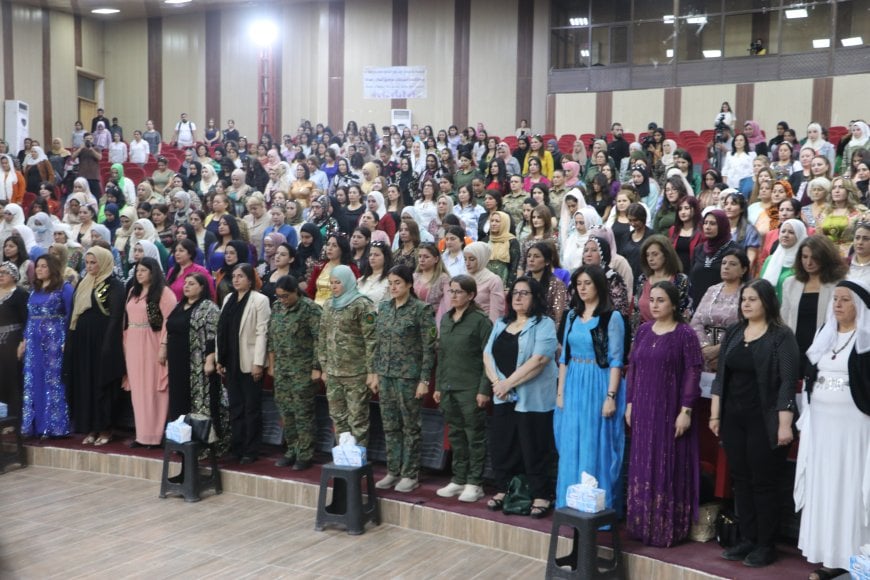
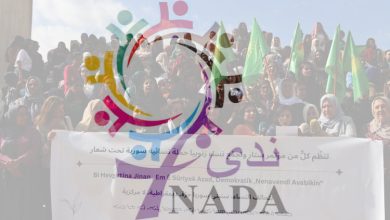
On September 20, in Hasakah, the conference “Women’s Alliance is the Foundation for Building Justice and Democracy in a Decentralized and Unified Syria” took place. In the face of the fundamentalist and misogynistic transitional government in Damascus, a united, strong response by women is vital. This conference is also a response to the elections that are taking place just in a part of the syrian territory, and moking women with the quota of 20%.
Throughout the day, women from diverse communities engaged in discussions. At the beginning, a series of speeches were given, while after, participants explored various themes in an open discussion. In addition to Kurdish, Arab, and Assyrian women, Alawite women also delivered speeches. From Sweida, a letter from students and a video message were received. The outcomes of the conference can be found in the final statement at this link.
The oppressive, patriarchal state has long relied on dividing women and suppressing their voices. Gatherings like this prove that women’s organization is not just resistance—it is a source of irrepressible power against a system that oppresses society as a whole. Once again, North and East Syria stand at the forefront of the global women’s struggle.
Here we share some excerpts from the speeches to give you a sense of the power of the discussions that took place.
The conference was jointly organized by Kongra Star and the Zenobia Women’s Association, bringing together women determined to shape the future of Syria. Rihan Loqo, spokesperson for Kongra Star, declared that the conference aimed to forge unity among Syrian women—a fierce and uncompromising response to the attacks targeting women and their very existence.
She mentioned the profound historical significance of this conference, as Syrian women have always fought—across every sphere of life—against nationalist and patriarchal regimes, since the Ba’ath regime. “Resistance to religious fundamentalism, racism, and misogyny has always been a constant struggle.”
Rihan Loqo emphasized that after the fall of the Ba’ath regime, the transitional government in Damascus systematically pursued a policy of erasing women: their rights ignored, their presence made invisible, their faces veiled in black. The genocides committed against the Druze and Alawite communities were part of the same fundamentalist agenda: she described the head of the Syrian government as a former leader of extremist militias and a murderer of women.
She declared that any government disregarding women’s struggle will be rejected; in the committees that had been formed, women were completely absent. She demanded at least 50% representation for women in all governing assemblies, insisting that peace in Syria can only be built with the voices of women and the peoples of this land as Kongra Star and the YPJ stand as living proof of this truth.
Khod Al-Ali, who lived under ISIS rule, spoke on behalf of the Zenobia Women’s Association, which is especially active in majority-Arab regions. She described how ISIS fundamentalism sought to erase women’s identities and strip them of their rightful role in society. The most brutal forms of violence—rape, abduction, and murder—were inflicted upon women.
She reminded the audience that this is a critical and dangerous moment in Syrian history. Now more than ever, we must take responsibility and ensure that history honors the sacrifices of the martyrs who gave their lives for this struggle. From her experience she shared the necessity to defend the achievements of the women’s movement in Syria for the future, and emphasized that women insist on resisting every form of violence.
She concluded by emphasizing that building a democratic Syria is no small task: it demands that everyone work together to create a society that respects women’s rights. “I call on all women to take an active role in this effort. We women are not the sacrifice to be paid—we are the vanguard of a new Syria.”
Speaking on behalf of Alawite women, Abir Selman emphasized that equality between men and women is not optional—it is a fundamental necessity for society, both inside the home and in the public sphere, since the two are inseparably linked. What she remarked about the experience in North and East Syria is that, within such a small territory, a system has been established that protects women and stands as a model for the entire world.
She asked: “How is it possible that in this land, a path was found to solve problems that are global in scale?” She concluded that this achievement is the direct result of the philosophy of the peoples’ leader, Abdullah Öcalan, whose ideas shape every social and political sphere. Selman stressed the urgent need to enshrine these changes in law, making them the very foundation of our society.
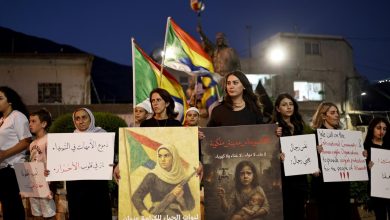
Speaking on behalf of the PYD, Fewza Yusef opened with the strong words: “We are women, we are beautiful, and we are free.” She then explained that this conference comes at a critical moment, as Syria is once again being rebuilt: until now, women’s rights have been ignored and their presence dismissed. She remembered the women who were massacred along the coast and in the Sweida region; they were sold, raped, and silenced. “We pledge to build a democratic Syria in their names as well.”
She denounced the transitional government in Damascus, which attempts to deceive women with empty promises of 20% representation: this is a mockery. She recognized how women in Syria have awakened—they have risen to their feet, fully aware that it was their struggle, their sweat, and their sacrifices that made this revolution possible. Fewza Yusef affirmed that women do not accept a façade pretending to recognize their rights—they demand real, concrete guarantees.
She denounced the fact that today, active women—intellectuals, academics, and all who raise their voices—are targeted by vicious smear campaigns on social media and even face death threats, including women within the Autonomous Administration. The transitional government in Damascus is complicit.
“They seek to belittle women, to silence us, just as ISIS once tried. But ISIS failed—and no threat, no bullet, will stop our struggle.”
She recalled the strength of the martyrs: when Hevrin Xalef was killed, hundreds of women stepped forward to continue her work. When Arîn Mîrxan fell, the occupiers expected the resistance to weaken. Instead, thousands carried her gun and continued the fight. “If we unite, no force on earth can stop the march of women. Bullets could not stop us—threats will not either.”
Fewza Yusef emphasized the urgent need to end the hate speech spread by the transitional government. In the name of religion, they betray ethics, weaponizing faith against social morality itself. She described how on one hand, they speak of dialogue; on the other, they label us infidels and call for our elimination. Speaking in the language of nationalism, fundamentalism, racism, and misogyny, peace cannot be built.
She called for a new language that embraces the full diversity of Syria. Syria’s different communities are not enemies—they are pieces of the same mosaic; to declare any component an enemy is to destroy all hope of peace. She shared how the experience in North and East Syria demonstrates that real peace is not only possible—it is already being lived.
Speaking on behalf of the YPJ, Rohilat Efrin reminded the audience that this revolution—rooted in the philosophy of the peoples’ leader, Abdullah Öcalan—has forged free women who fight a just struggle with their own will and strength. Those who made this possible are our martyrs and all who gave everything for the revolution: without them, we would not be here. She invited the audience to feel the strength of the thousands who have written legends through their actions.
She emphasized that the spirit and mindset of self-defense are what have allowed us to survive and advance. She mentioned how the creation of a defensive force made it possible for women to continue living freely in the territories they inhabit, and this mindset must become part of the life of every woman in Syria; had the women of Shengal, the coastal areas, and Sweida possessed a strong system of self-defense, they might have been spared genocide, rape, and abduction.
“Now more than ever, women must join the defense forces—just as they did when faced with ISIS.”
On behalf of the YPJ, Rohilat Efrin renewed the pledge to continue defending Syria whenever called, across all of Syria. “We promise to defend a multicultural, multi-religious, and multi-ethnic Syria.” A female defense system is being built that includes women from every community. She emphasized that the philosophy of self-defense must become a central part of the life of every woman in Syria, because we know there is no place that is completely safe.
This conference shows us once again that in North and East Syria and in all Syria, women continue to resist with unwavering strength, clear vision, and unbreakable solidarity. We again saw the truth: women are carrying the struggle for democracy with the greatest intensity. They are fearless, because their unity is already shaping a future that no sham election can erase or undermine.